Pissarro, Camille (1830-1903)
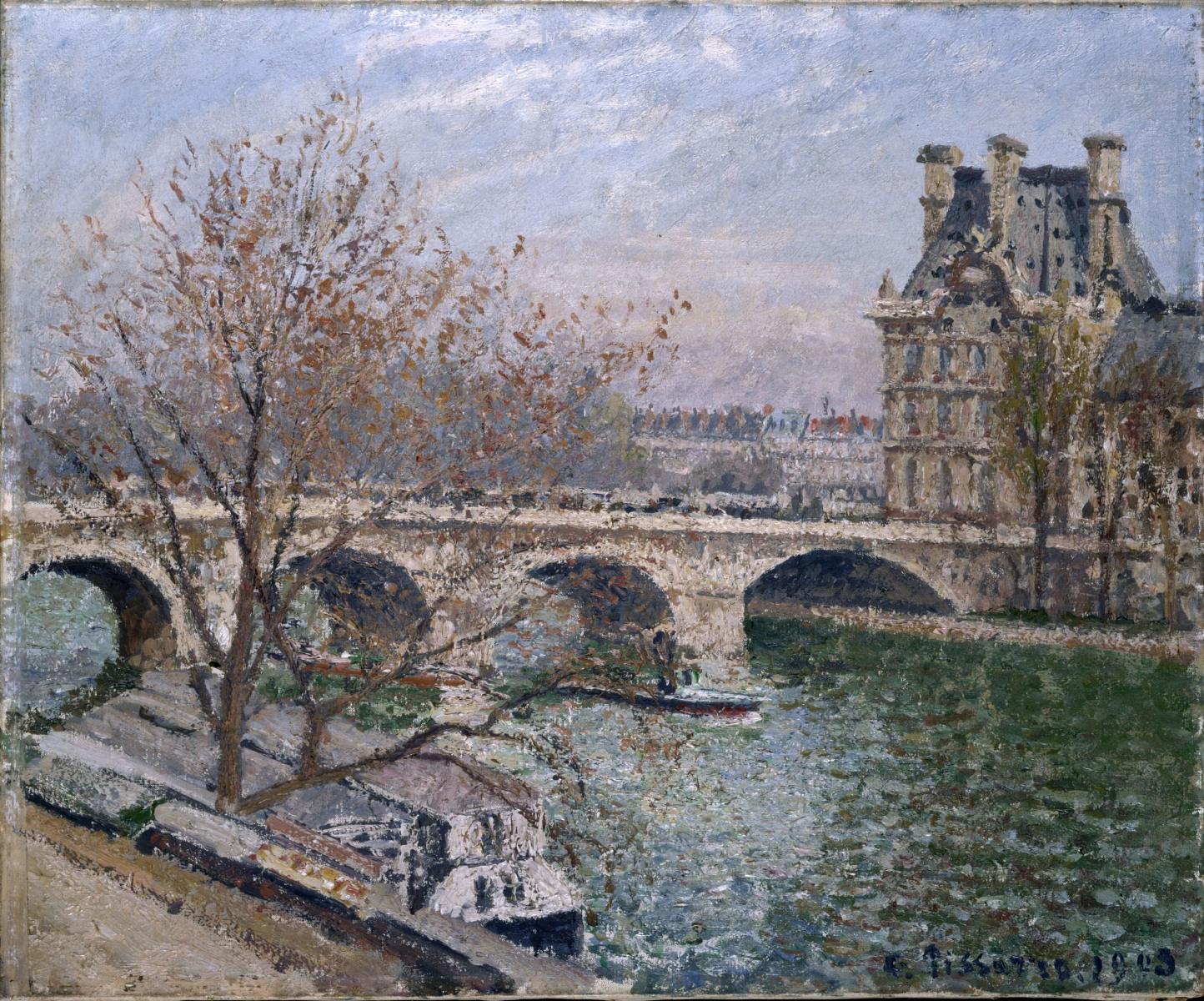
Le Pont Royal et le Pavillon de Flore (The Pont Royal and the Pavillon de Flore)
1903
Oil on canvas, 54.5 x 65 cm
Petit Palais, Paris
In the spring of 1903, Pissarro temporarily moved into a hotel on Quai Voltaire, on the left bank of the Seine. From his room he could see the Pont Royal and the Pavillon de Flore, at the end of the Louvre buildings along the Seine, at the south-west end.
Around 1890 the Impressionists all left Paris, abandoning the field of urban painting. Conversely, Pissarro, who had above all been a painter of land and rural life, devoted part of his work to city landscapes during the final decade of his life. This aspect of his work includes series of ports and bridges resulting from travels to Normandy, Rouen, Le Havre and Dieppe, as well as views of the centre of Paris, the boulevards, the Louvre Palace and the banks of the Seine.
After following the principles of neo-Impressionism, his painting returned to the style of the 1870s, with a finely-worked pictorial surface, well-structured compositions and a light palette. These urban landscapes, like the one owned by the Petit Palais museum, were always painted from a dwelling, giving a higher viewpoint than at street level. This choice of position was partly due the painter’s poor sight, as well as a desire to capture the coming and going of city life from a stable observation point offering a broad field of vision.
Here Pissarro has used pastel shades applied in dense and almost coarse touches to portray the light of a spring morning. The quadripartite composition, water – sky – left bank- right bank, is arranged symmetrically around the axis of the bridge, which gives depth and balance to this high angle view.
This landscape was one of the last painted by Pissarro who died a few months later. He completed the Parisian pictorial journey begun at the Tuileries, four years earlier, making the Louvre the central focus of these later urban years. This painting was purchased by the City of Paris from the painter’s fourth son, Rodolphe Pissarro, in 1905. (Petit Palais)