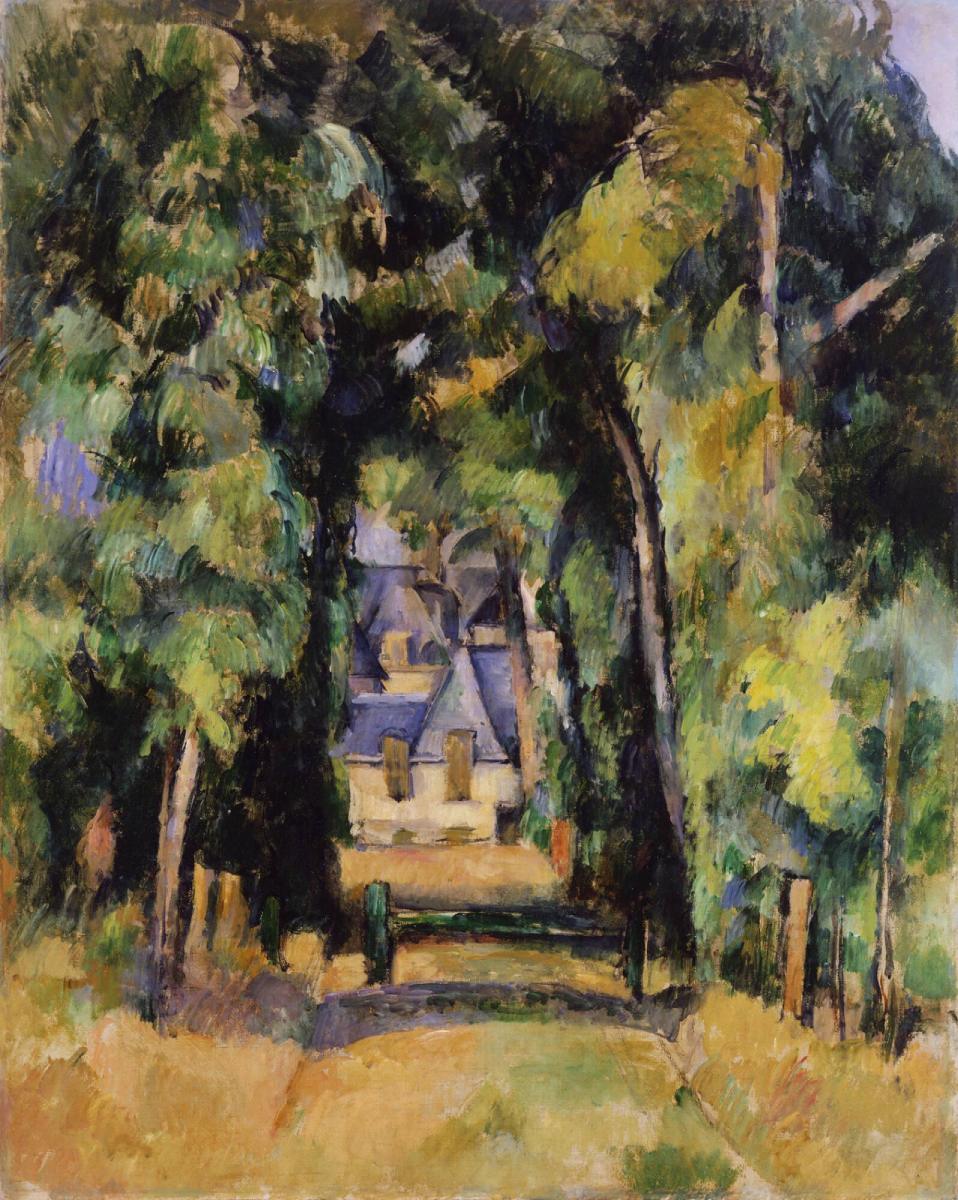
Cézanne, Paul (1839-1906)
Avenue de Chantilly (Avenue at Chantilly)
1888
Oil on canvas, 81.3 x 64.8 cm
Toledo Museum of Art, Toledo
Paul Cézanne combined classical structural stability with a new sense of respect for the inherent two-dimensionality of painting. By doing so, he established tension between the illusion of spatial depth and the flatness of the painted surface. In Avenue at Chantilly he denied a deep, tunneling plunge toward the house in a variety of ways. The dense blue shadows beneath the trees, the brightness and clarity of the distant building, and the undefined edges of the path disrupt a coherent recession into depth, flattening out the image. He also strategically repeated colors with hatch-like brushstrokes throughout the canvas. Often called the “Father of Modern Art,” Cézanne had a direct influence on two of the most important artists of the 20th century: his color theories had a great impact on Henri Matisse (1869–1954), and his geometric structure of space led Pablo Picasso (1881–1973) toward the development of Cubism. (TMA)