Gauguin, Paul (1848-1903)
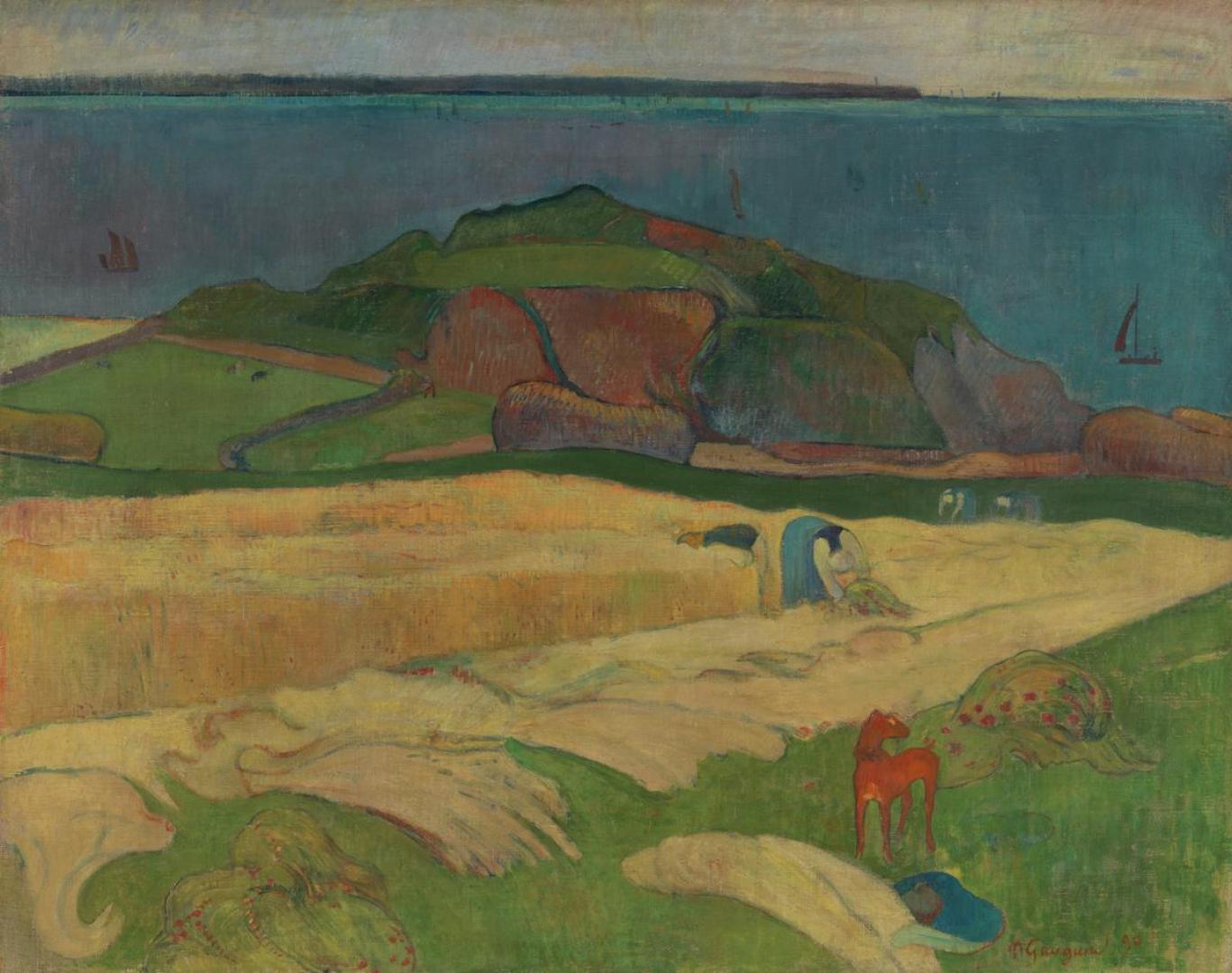
Moisson, Le Pouldu (Harvest: Le Pouldu)
1890
Oil on canvas, 73 × 92.1 cm
Tate Britain, London
In 1890 Gauguin was staying at Marie Henry’s boarding house in Le Pouldu, Brittany. The headland in this painting is at the western end of the beach, about a mile from the village itself. Gauguin painted other versions of this landscape, all of which are characterised by the strongly defined forms and flat areas of colour of his Synthetist style. He also used it in a simplified form for the background of his Symbolist work, ‘The Loss of Virginity’, painted in Paris in the winter of 1890–91 (Norfolk, Virginia, The Chrysler Museum).
In this painting Gauguin was experimenting with a new way of expressing his emotions through strong colour contrasts. This approach is known as Synthetism. He reduced the cut corn, the fields, cliffs and stone walls to blocks of purple, green and yellow. The thin strip of sky is a dirty white and there is a strange bright red dog in the foreground. The women harvesters are bent over their work. The dog has a slightly sinister yellow eye. It is a troubling presence, apparently alert to something we cannot see. The setting is the headland above the little resort of Le Pouldu in Brittany, where Gauguin tried to escape from the suffocating atmosphere of Paris. ‘Give me the country. I love Brittany: I find the wild and the primitive here. When my clogs resonate on this granite ground I hear the muffled and powerful thud that I’m looking for in painting’, he wrote. (NG)
Gauguin executed this harvest scene whilst staying at Le Pouldu in Cap Finistère, Brittany. He had been the central figure of a group of painters at the nearby village of Pont-Aven. Then in 1890 he moved to Le Pouldu in search of an even simpler way of life. By this time Gauguin had abandoned his early Impressionist manner. Influenced by folk art and primitive art, he began to use flat areas of colour and a distorted perspective in his paintings. The landscape and life of the peasant community inspired some of the most rugged and radically simplified works of his career. (Tate)
See also:
• Bretagne | Clohars-Carnoët (France)