Picasso, Pablo (1881-1973)
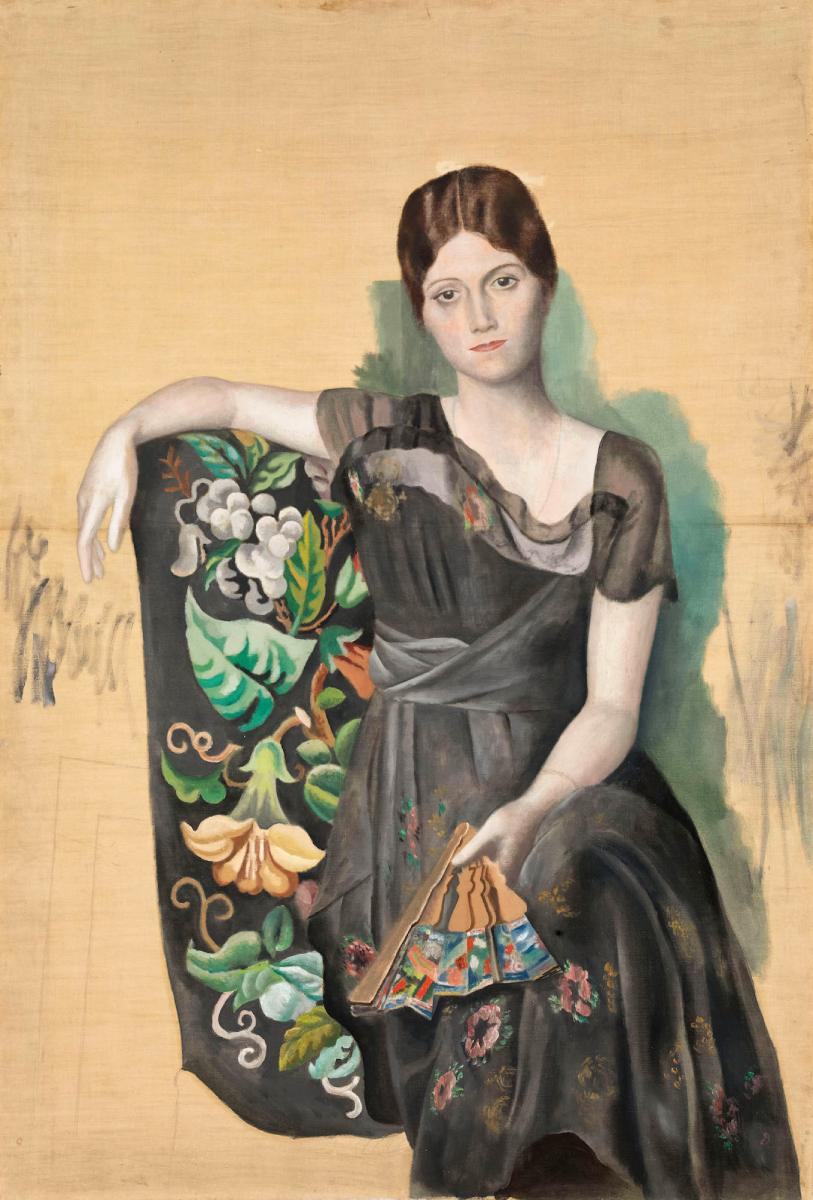
Portrait d’Olga dans un fauteuil (Olga in an Armchair)
spring 1918
Oil on canvas, 130 x 88.8 cm
Musée Picasso, Paris
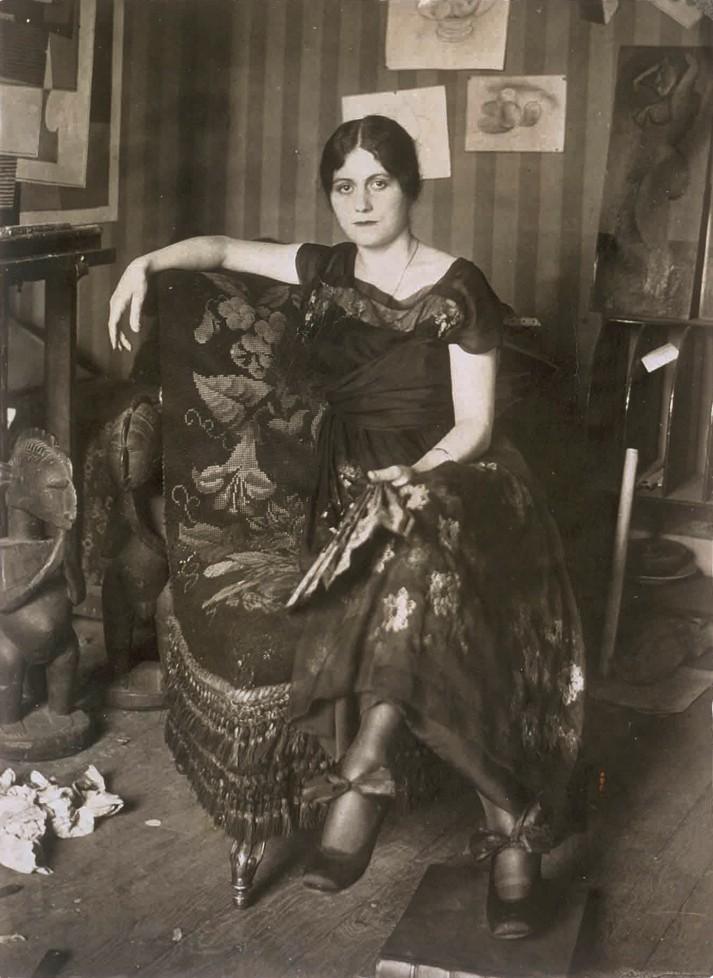
Olga Khokhlova in Picasso‘s Montrouge studio, spring 1918.
Olga Khokhlova was the first woman Picasso married, in the summer of 1918. Here, the painter portrays this dancer from the Ballets Russes, whom he met in Rome the previous year. She is seated in an armchair, a static, constrained pose that Picasso favored for his portraits of women throughout his life, and one of which he explored numerous variations. He painted his fiancée from a photograph preserved in the archives of the Musée Picasso, to which he remained remarkably faithful, even reproducing the exact floral pattern of large leaves and flowers on the armchair’s upholstery, the pink corollas with small green leaves of the flowers on the silk dress, the detail of the decoration on the wooden fan that appears disjointed, and Olga‘s hairstyle with its center parting. Picasso remains faithful to the original image, except that the Montrouge studio where he lived at the time and where the photograph was taken disappears into the background, as do the seat and legs of the armchair and those of the dancer, giving way to the raw canvas and a few brushstrokes crudely depicting a shadow. The woman is caught in the painting, by the painting, even when she appears posed, classical, and calm, a world away from the eroticism that, in Picasso‘s work, often conflates the woman and the model, the painting and sex.
This Olympian calm conceals another kind of cannibalism. Olga Kokhlova is painted in the manner of a society portrait by Jean-Dominique Ingres: the velvety curve of her arms and neck, her studied and motionless pose, her face whose natural harmony is further accentuated by Picasso in the direction of symmetry and balance, the patterned garment’s tendency to assert itself by revealing only a few slivers of flesh. One thinks of Madame Moitessier (1856, National Gallery), whom Picasso may have seen in London a few months earlier, in the Portrait of Madame de Sennones. Pablo Picasso had already taken on Ingres for his massive women and his bathers of the 1906 period; here, he returns to him to make his fiancée a socialite of painting – we should emphasize in this regard the elegance of Olga: a dress with a loose waist that could well come from Paul Poiret, and which already announces the more comfortable body of the 1920s, a Spanish-style wooden fan, reminding us to whom she is promised?
In 1918, Picasso painted in all sorts of styles. His classicism was not yet unified. Yet, as soon as the artistic community learned, upon hearing of, for example, the pencil portrait (MP1998-307) he created of Max Jacob in 1915, that “Picasso paints like Ingres,” in the midst of a Great War that brought together a large number of modern painters in the French and German trenches, a second world collapsed. Other portraits of seated women, cold and melancholic, would follow this one, those of the Return to Order that marked all of Europe. In France, André Derain painted the Portrait d’Alice Derain (1920–1921) and the Portrait of Lucie Kahnweiler (1922), Roger Bissière the Portrait of the Seated Woman in Gray (1921). Man Ray amassed icy photographs of society women (MNAM). In the Italy of the Valori Plastici, that of Chirico (Portrait of the artist with his mother, 1919, MNAM), Soffici and Severini (The artist’s wife and daughter, 1934, MNAM), it is neo-classicism that triumphs, as with some German painters of the New Objectivity (Christian Schad, Marcella, 1926, private collection). (MNPP)
See also:
• Khokhlova, Olga (1891-1955)