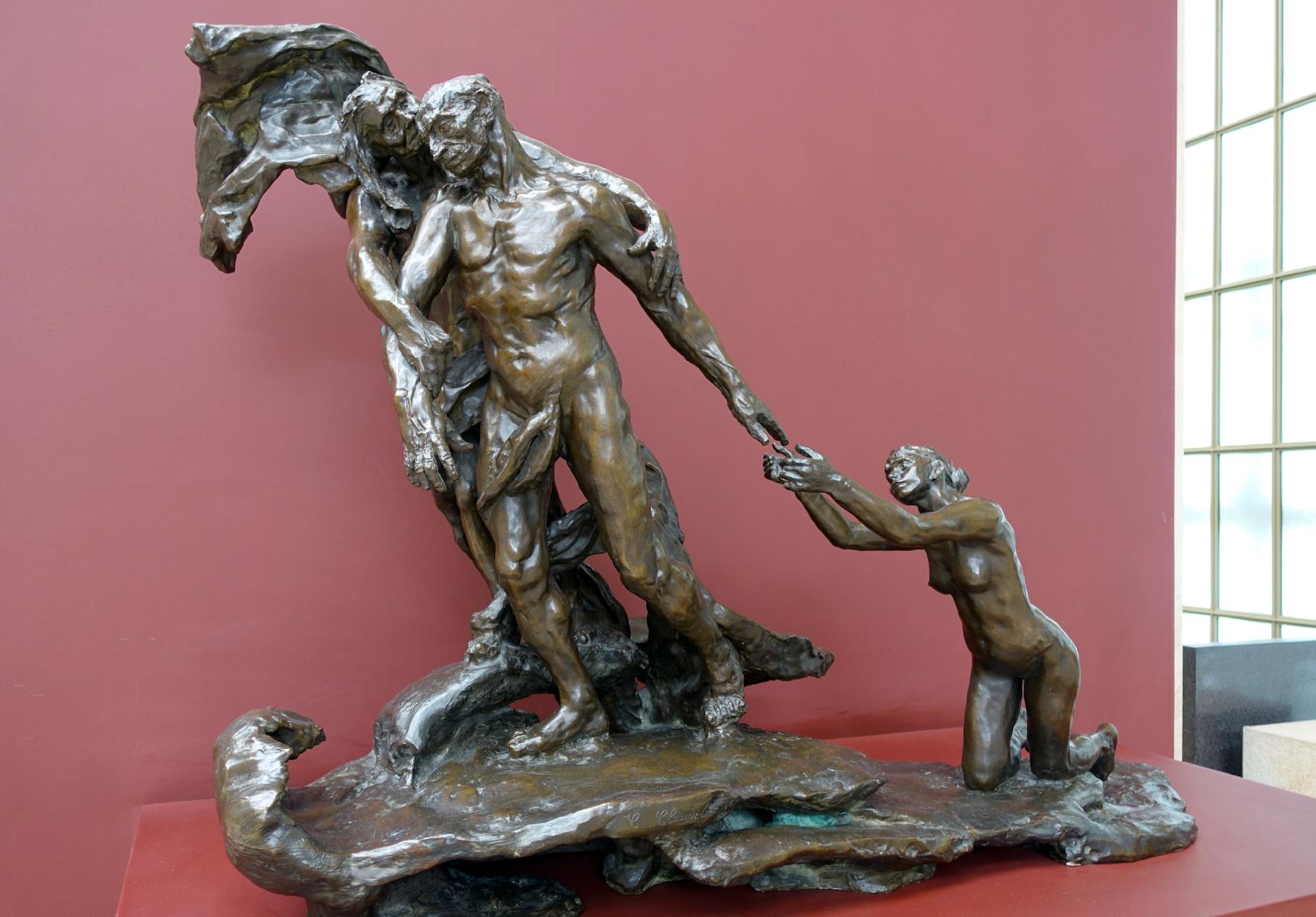
Claudel, Camille (1864-1943)
L’Âge mûr (Age of Maturity)
1899
Bronze, 61.5 x 85 cm x 375 cm
Musée Camille Claudel, Nogent-sur-Seine
With The Age of Maturity, Camille Claudel demonstrates her artistic mastery and creativity, now fully mature. The artist addresses the passage of time, old age, and death—themes dear to the Symbolists. The perfectly controlled composition conveys the inexorable flight of time: a diagonal line connects the body of the supplicating young woman to the outstretched hand of the man and the drapery of the old woman. The different levels of the terrace further accentuate this progression, the outcome of which can only be death. The artist excels at representing several moments in the same story: the young woman displays pain followed by resignation, the man tries to resist but is already succumbing to it. Above all, Claudel plays with negative space, which is an integral part of the work: the space between the hands of the man and the woman alone expresses all the emotional tension of this moment.
Mentioned as early as 1890 in a letter from the artist, The Age of Maturity had a long genesis and was first exhibited to the public in 1899. After more than ten years of exchanges and negotiations between Camille Claudel and the French state, the public commission for this work in marble or bronze never materialized. However, a private collector, Captain Tissier, commissioned The Age of Maturity in bronze, which was cast in 1902. Then, starting in 1907, Eugène Blot, gallery owner, publisher, and staunch supporter of the sculptor, marketed a bronze reduction of this group.
This work has often been reduced to its autobiographical dimension. But while the sculpture reflects her separation from Auguste Rodin, Camille Claudel primarily evokes the human condition: this allegory of the ages of life, showing the passage from youth to maturity and then to old age, has a universal significance. Above all, the sculptress asserts her artistic autonomy, through an expressiveness, a treatment of space and an inner life of the characters that belong only to her. (MCC)