Cézanne, Paul (1839-1906)
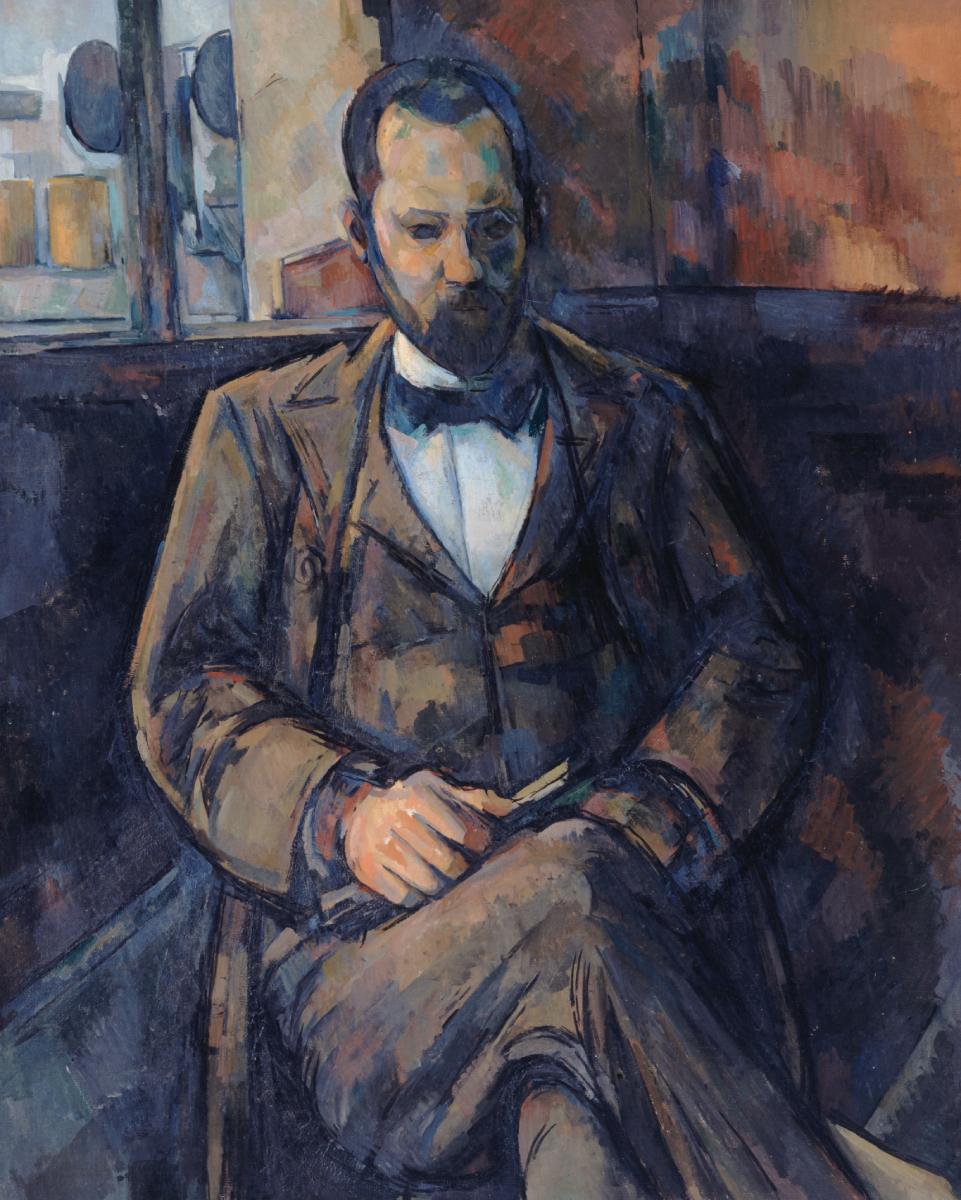
Portrait d’Ambroise Vollard (Portrait of Ambroise Vollard)
1899
Oil on canvas, 100 x 82 cm
Petit Palais, Paris
According to Ambroise Vollard (1866-1939), this portrait, undertaken by Cézanne in his studio near the Montmartre cemetery, required 115 morning sittings. It testifies to the close relationship of trust between the painter and his art dealer, who, in 1895, took charge of Cézanne‘s commercial career. At 55 years of age, the master from Aix had remained outside the Parisian art market, although young artists saw in him a pioneer who was breaking new ground.
“I posed a number of times.” With this simple sentence, Ambroise Vollard opens a short chapter of his memoirs, Souvenirs d’un marchand de tableaux (1937), entitled “My Portraits.” In it, the art dealer recounts some delightful anecdotes about his sittings for various painters.
Cézanne inaugurated the practice in 1899 with countless sittings where silence was the rule, and Vollard, perched precariously on a stool, had to remain as still as a statue on a pedestal table. At Renoir‘s studio, the atmosphere was more relaxed, and one could talk and even move around. Bonnard, aware of his model’s tendency to fall asleep, placed a small cat on his lap to keep him awake.
Other artists on Rue Laffite would also participate in this practice: Louis Valtat, Pablo Picasso, Emile Bernard, Jean-Louis Forain, Raoul Dufy, and Georges Rouault. Some portraits are veritable artistic manifestos, such as those painted by Cézanne (Paris, Petit Palais) and Picasso (Moscow, Pushkin Museum), which offer a striking demonstration of the Aix master’s influence on the birth of Cubism.
Vollard was aware that he was working for posterity by associating his likeness with the artists he helped to promote. His generosity towards the Petit Palais, which received numerous paintings, sculptures, ceramics, books, drawings, and prints from him, confirms this. (Petit Palais)
See also:
• Vollard, Ambroise (1866-1939)