Maar, Dora (1907-1997)
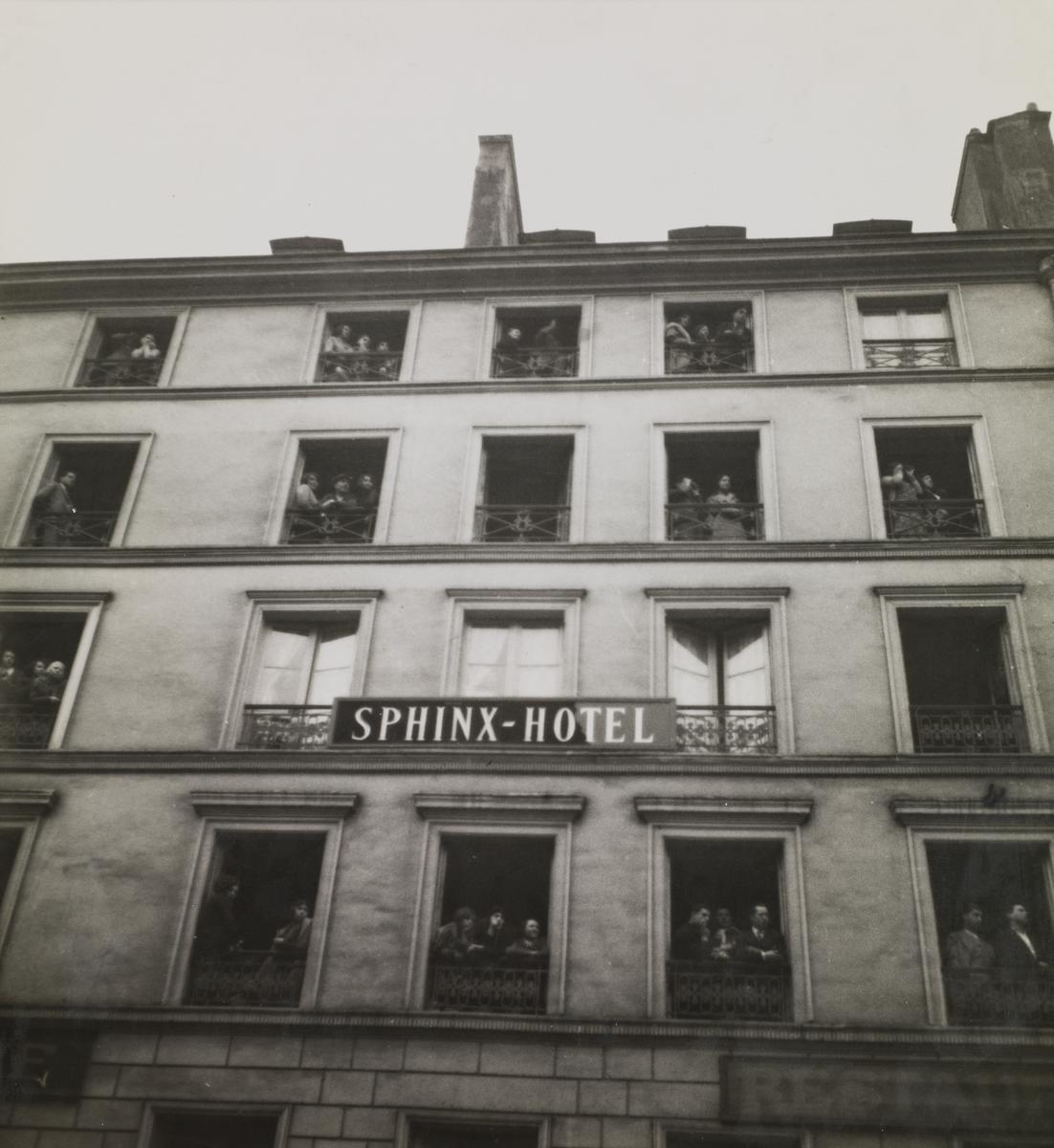
Sphinx-Hôtel (Untitled)
1935
Gelatin silver print on paper, 25.8 × 23.9 cm
Tate Britain, London
Untitled (Sphinx-Hôtel) 1935 is exemplary of Dora Maar’s surrealist-inflected street photography. The black and white photograph depicts a foreshortened view of the Sphinx-Hôtel in Paris as captured from street-level looking up. Each of the building’s windows is filled with guests looking down in the same direction, though it is not made clear at what. One woman is holding binoculars.
During the 1930s Dora Maar earned a living through commercial assignments, mostly for fashion and beauty brands. Between 1932 and 1934 she shared a studio in Neuilly-sur-Seine with the filmset designer Pierre Kefer. During this period and, for reasons unknown beyond their professional collaboration, Maar often stamped her prints ‘Kefer-Dora Maar’ on the verso. Untitled (Sphinx-Hôtel) is one such example.
While taking professional assignments, Maar also worked independently. She experimented with photomontage, took portraits of her friends in the surrealist circle and she used her Rolleiflex camera to take documentary photographs in Barcelona, London and on the outskirts of Paris, often focusing on the most disadvantaged groups in society. Her surrealist-inflected street photographs made in Paris and London connect the different aspects of her practice. Focusing on street signage, shop fronts and architectural details shot from unexpected angles, these photographs reveal Maar’s distinct eye, but also the artistic and literary sources in which she found inspiration. Among them are the photographs of historic Paris by Eugène Atget (1857–1927, whose Documents for Artists had recently gained the attention of the surrealists) and the work of her contemporary, Brassaï (1899–1984), with whom she once shared a darkroom and who once stated in his landmark photobook Paris by Night (first published by Flammarion in 1933) that ‘nothing is as surreal as reality itself’.
Studying Maar’s influences, art historian Dawn Ades has noted that Untitled (Sphinx-Hôtel) is: a direct reference to one of the most haunting Surrealist books, André Breton’s Nadja (1928), the account of a failed love affair, and to the photographs in it by [Jacques-André] Boiffard. Breton asked Boiffard to photograph the sites in Paris where his encounters with Nadja took place, including the Sphinx Hôtel on the Boulevard Magenta, where, upon arriving alone in the city, his protagonist chooses to live, simply on account of its name. Did Maar photograph the same hotel? It must be, although its sign is different in Boiffard’s photograph, and the sphinx heads are invisible.
(Dawn Ades, ‘Chance Encounters and the Modern Marvellous’, in Centre Pompidou 2019, p.78. (Tate)