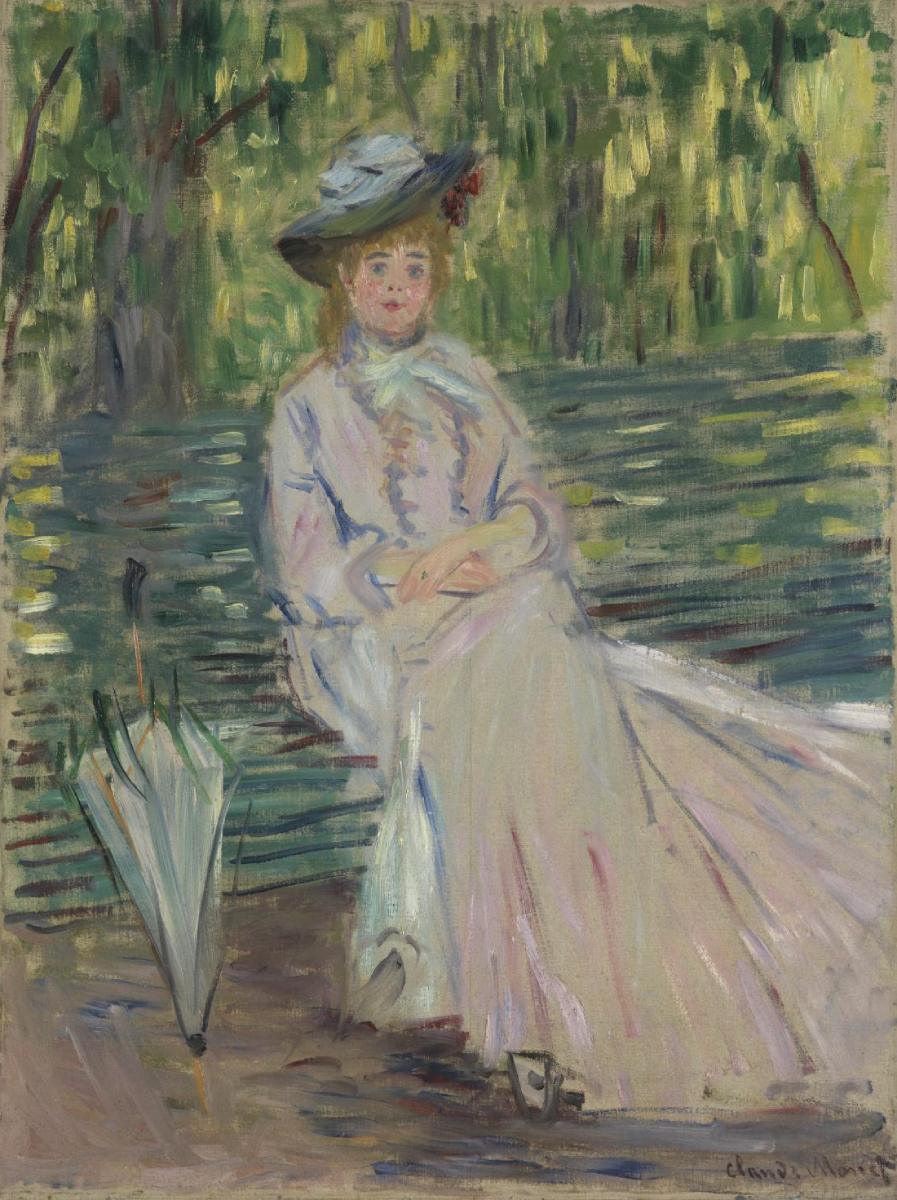
Monet, Claude (1840-1926)
Femme assise sur un banc (Woman Seated on a Bench)
c.1874
Oil on canvas, 73.7 x 55.9 cm
Tate Britain, London
This picture has also been known under such titles as ‘In the Park’, ‘Woman in a Park’ and ‘Resting’, and appears in the Durand-Ruel files as ‘In the Park (Portrait of Madame Monet)’. However Mme Blanche Hoschedé-Monet told Oscar Reuterswärd in 1947 that it does not represent her mother, Camille, but a model, whose name she had forgotten, who also sat to Degas and other artists. Jean-Pierre Hoschedé subsequently confirmed (letter of 21 July 1954) that both he and Camille‘s son Michel Monet were quite sure it could not be her. The exceptionally free handling seems to reflect the influence of Manet and it may have been painted in the summer of 1874 at Argenteuil at a time when Monet and Manet were painting together, sometimes side by side. There is an inscription on the stretcher which reads ‘jeune femme sur un banc par Monet | Vollard‘ (girl on a bench by Monet | Vollard). (Tate)
This painting features a young woman sitting on a bench in a garden. It is likely to be the garden of Claude Monet’s house in Argenteuil, in the north-western suburbs of Paris. Monet painted this work in 1874, the same year in which he showed Impression, Sunrise (Musée Marmottan Monet, Paris), the painting that would give Impressionism its name.
The woman is relaxed and graceful. Bathed in golden summer light, she is looking confidently out of the canvas at the viewer. She is fashionably dressed, with her parasol neatly propped against the bench. Monet’s handling of the paint is very free and loose, and has been described as a form of painterly shorthand. The informality of this depiction of the woman is striking and beguiling.
Monet came to Argenteuil in 1871 looking for a rural escape from Parisian life. From the 1860s the town had become increasingly popular as middle-class people began to buy and rent properties. This trend was actively encouraged by the municipality, which wanted to attract Parisian money into the town.
The town was only 11 kilometres by train from Paris, which took about 15 minutes. From Monet’s house he could hear the train, see other houses and watch new houses being built. However, all his depictions of his garden in Argenteuil show it as rural, bucolic and verdant. In this painting there is no hint of modern life. The young woman is portrayed in a lush, tranquil setting.
In 1874 he moved to a larger, rented house. Monet always spent what he earned, but had started to be moderately successful and employed two maids, a gardener and a nanny. In 1874 Manet often visited Monet and painted Madame Monet and her son, Jean, in their garden. It is possible that the free handling of his work was influenced by Manet. Monet was visited by his friend Pierre-Auguste Renoir too, who also painted his garden.
Monet frequently painted his first wife, Camille, while they were at Argenteuil. For many years it was thought that this lady was Camille. In 1947 Blanche Hoschedé-Monet, the daughter of Monet’s second wife, revealed that the sitter was not Camille but a model, whose name she had forgotten. This was confirmed by her brother Jean-Pierre Hoschedé and Camille’s son Michel Monet. Regardless of the identity of the young woman, Monet was portraying a scene of youth, summer and possibly even love. (NG)