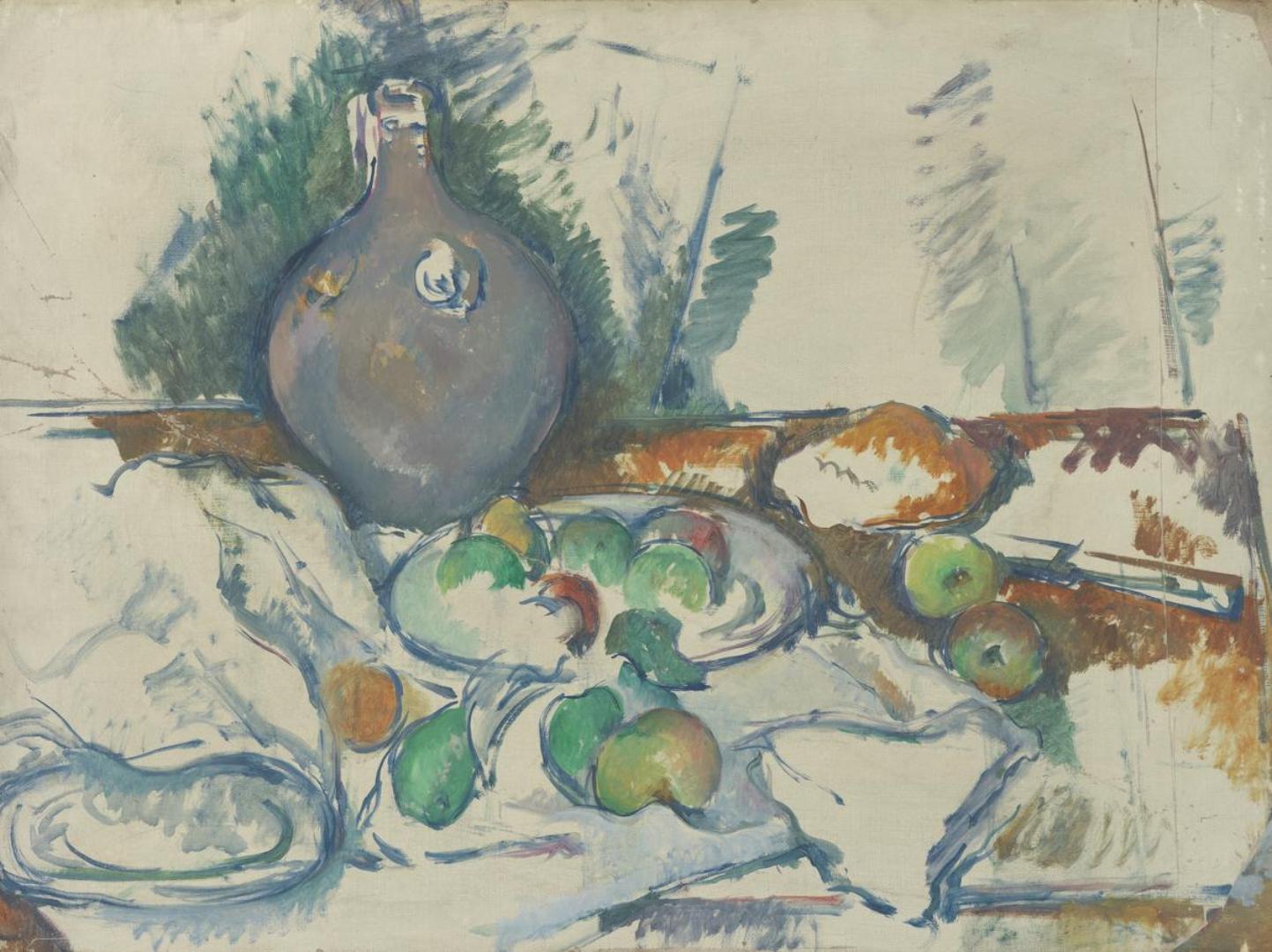
Cézanne, Paul (1839-1906)
Nature morte à la cruche (Still Life with Water Jug)
c.1892–1893
Oil on canvas, 53 × 71.1 cm
Tate Britain, London
Cézanne was preoccupied with still life, and painted the same objects over and over again. His concentrated study of familiar items enabled him to develop a new way of capturing his visual sensations. He believed that conventional perspective, which uses a single viewpoint, did not accurately reflect the way that we perceive the world. In this painting, he combined several viewpoints of the fat-bellied jug and fruit. Like many of his works, it was left unfinished. (Tate)
Because it was left unfinished, this picture is a fascinating insight into how Cézanne planned and executed his still-life compositions.
At the first stage he used sketchy brushstrokes of very dilute blue-grey paint to set out the key angles of the perspectives he wanted to create: the tabletop, the knife set diagonally on it and the cloth hanging over the front edge. He then roughed out the outlines of the main components. We can see the shapes of the plates, the folds of the tablecloth and the drapery backdrop.
At the next stage he sketched in some of the predominant colour of each object with a few quick brushstrokes: the orange crust on the bread and the green and yellow pears and apples, and the brown table, for example. Then he worked more intensively on each object. Here, the form and colouring of the water pitcher are nearing completion. (NG)