Toulouse-Lautrec, Henri de (1864-1901)
Émile Bernard
1886
Oil on canvas, 54 x 44.5 cm
Tate Britain, London
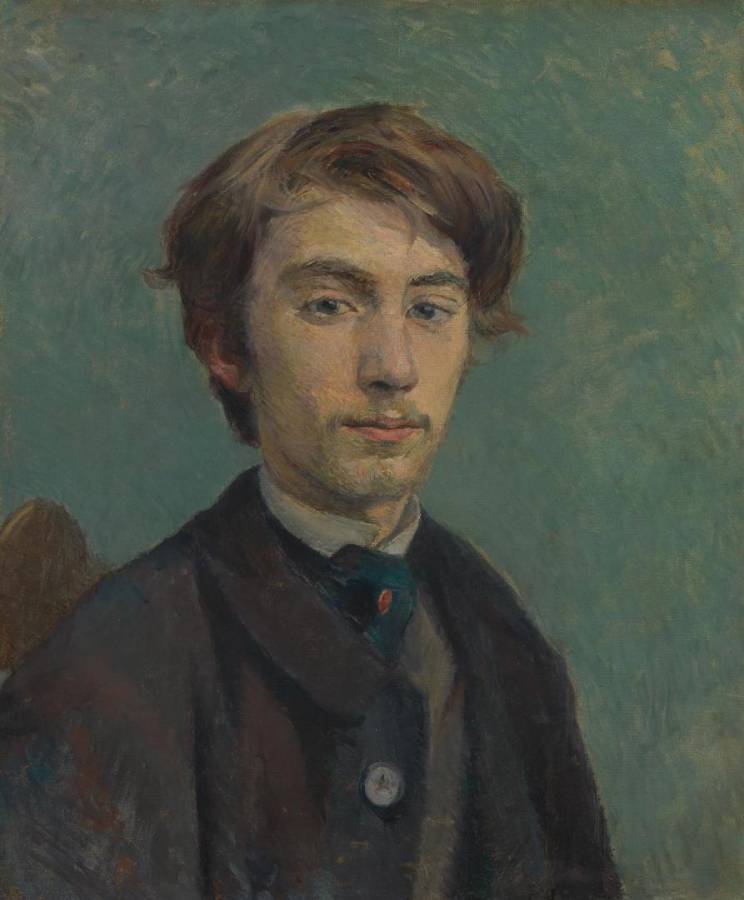
This is a portrait of the painter Emile Bernard. At the time it was done Bernard was still only a teenager, and was a student with Toulouse-Lautrec and Van Gogh at the Atelier Cormon in Paris. Like Gauguin, another of his friends, Bernard went on to develop a radical style of painting in his Breton scenes, for which he is now best known. Bernard later recalled that it took Toulouse-Lautrec thirty-three sittings to complete this picture, ten of which were devoted to working on the background. (Tate)
Emile Bernard was a fellow student of Toulouse-Lautrec with a reputation for artistic audacity. He entered Cormon‘s atelier in Paris in 1885, but was expelled in the spring of 1886. Bernard sat twenty times for this portrait, in which Lautrec portrays him more as a young bourgeois than a radical artist. It was probably painted in 1886, when Lautrec moved into his studio in the rue Caulaincourt, Montmartre. It was common for students to sit for each other at the time, as the practice provided convenient and free subject matter. Bernard himself drew a sketch of Lautrec.
A young man looks towards us with a rather reserved expression on his face. He sits upright, a little tense, alert perhaps, on a wooden chair, as he looks down at us from a slight height. Not quite smiling, his sideways glance is hard to read. Is he meeting our gaze, or staring past us? We can see the hint of his eyes narrowing, but otherwise, he remains impassive.
This is the artist Émile Bernard painted by his fellow student, Henri de Toulouse-Lautrec. Bernard would later become a radical and influential Post-Impressionist painter. He became famous working with the Pont-Aven School of artists in Brittany. But here, Toulouse-Lautrec shows Bernard not as an artist but as a respectable middle-class young man. He is formally dressed in a stiff collar, cravat, waistcoat and what looks like a velvet morning coat.
Toulouse-Lautrec had to labour hard to achieve the desired effect in this painting. Later in life, Bernard told the art historian Douglas Cooper that it had taken 33 sittings to complete the portrait. Ten of these were devoted to working on the muted blues and yellows of the background. Bernard said that Toulouse-Lautrec struggled to make it ‘fit the face’.
It is not a surprising story. Both artists were still learning their craft. When Toulouse-Lautrec made this portrait in 1885, he was just 21 and Bernard was only 18. They were both students in Paris at the workshop of the painter Fernand Cormon and had recently become friends. Cormon’s atelier was highly regarded. He attracted a talented group of students, including, in early 1886, the 33-year-old Vincent van Gogh. The trainee artists often sat for each other. It saved paying for a model. They could also exchange ideas and see how each other worked.
Far from being the restrained character we see in this portrait, Bernard had a strong rebellious instinct. Maybe the couple of rogue curls that have escaped from his thick mop of brown hair give us a clue. The bright red tiepin in the middle of his cravat might also hint at his true personality. Cormon encouraged his students to experiment. But he also wanted them to develop a formal academic style that reflected the teachings of the École des Beaux-Arts, the Parisian state-sponsored art academy. This was too restrictive for Bernard. In the spring of 1886, soon after this portrait was made, Cormon expelled him from his atelier. Bernard had decorated the curtain behind the life models with brightly coloured paints.
Toulouse-Lautrec was also ready to move on. He was just beginning to achieve some artistic success. He had started being a regular at the cafés, cabarets and brothels in Montmartre, and was winning commissions for drawings and illustrations. He thrived in this edgy bohemian world of entertainers and sex workers. Here, he could exhibit his work and create his own style. (NG)
See also:
• Bernard, Émile (1868-1941)