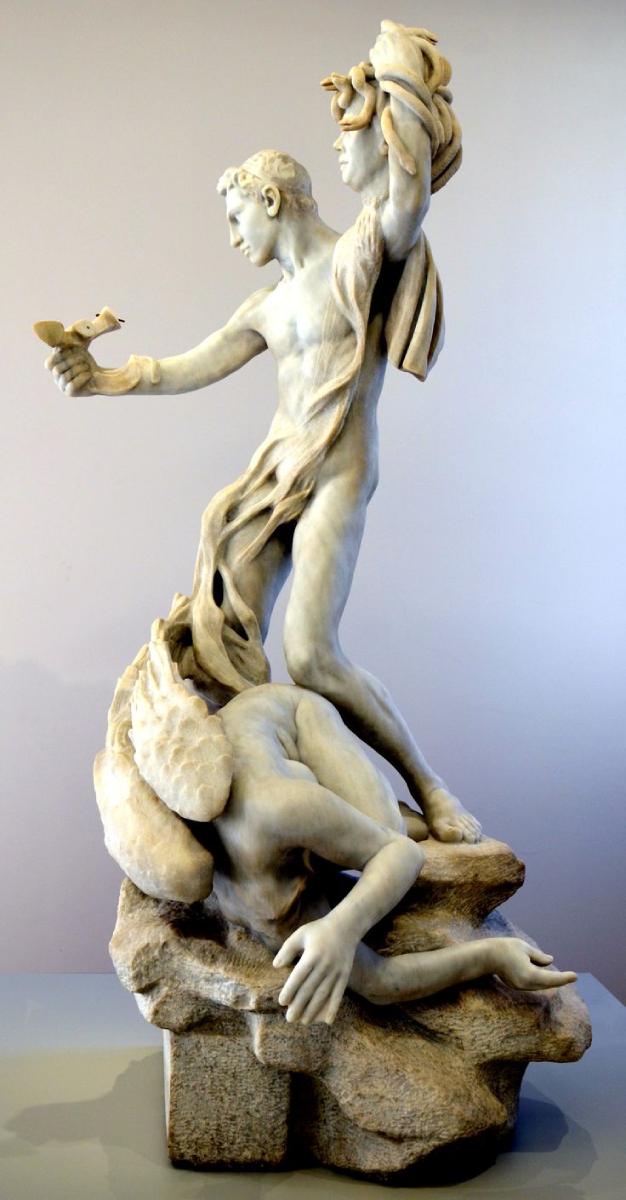
Claudel, Camille (1864-1943)
Persée et la Gorgone (Perseus and the Gorgon)
c.1897
Marble, 196 x 111 x 90 cm
Musée Camille Claudel, Nogent-sur-Seine
“It’s Medusa!” “It’s Percy Jackson!” As soon as they catch sight of Perseus and the Gorgon, a marble sculpture by Camille Claudel, children are delighted to recognize the subject of the work thanks to a series of novels written just for them.
This version, completed in 1902, is Camille Claudel’s only monumental marble sculpture. Commissioned by the Countess of Maigret, the artist’s patron, the carving was entrusted to François Pompon, based on the plaster model exhibited at the Salon du Champ-de-Mars in 1899.
Greek mythology is indeed the source of inspiration. Athena transformed the three Gorgon sisters into monsters in revenge. Their hair, which once made them irresistible to their suitors, was replaced by snakes, and the goddess adorned them with golden wings. They also had the power to petrify anyone who met their gaze. Perseus, however, manages the feat of beheading Medusa, the only mortal of the three Gorgons, using his polished shield as a mirror to see her without looking.
Perseus is triumphant. Snakes coil around the arm of the victorious hero, who brandishes the head. Interlacing patterns representing blood flow from the Gorgon’s neck and mingle with drapery, directing the viewer’s gaze to Medusa’s headless body, which lies curled up. In his right hand, Perseus held a shield, which has since disappeared. The subject of the sculpture is easily identifiable: Camille Claudel depicts both the victor’s joy and his recent struggle against the creature. As for the figures’ poses, the artist borrowed them from two of her earlier works, The Waltz and The Crouching Woman. From whom, then, did the Gorgon’s face derive its features? Paul Claudel wrote in 1951 in Ma sœur Camille: “That face at the end of that raised arm, yes, I seem to recognize its decomposed features.”; without saying so explicitly, the writer implies that his sister had depicted herself. (MCC)