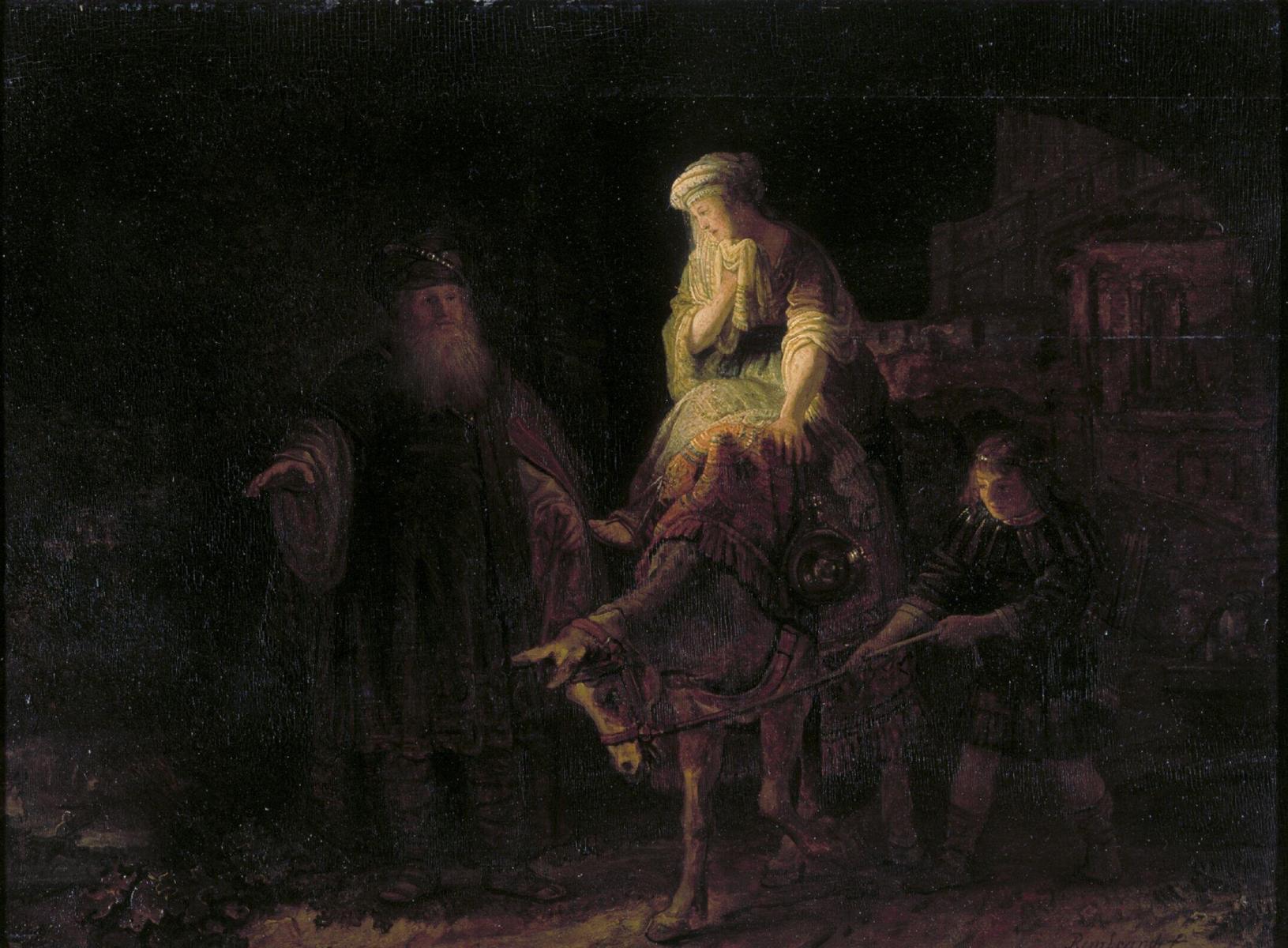
Rembrandt (1606-1669)
Abraham dismissing Hagar and Ishmael
1640
Oil on oak panel, 39 × 53.2 cm
Victoria and Albert Museum, London
CAI.78 is signed and dated Rembrandt f. 1640, and was generally accepted as an autograph work until 1973. However, the earliest documented reference of 1671 to what appears to be CAI.78 already attributed it to ‘a disciple of Rembrandt‘. In vol. 3 of the Corpus of Rembrandt Paintings produced by the Rembrandt Research Project (1989) it is identified as ‘A work probably executed in Rembrandt‘s workshop in 1640, perhaps attributable to Ferdinand Bol’.
Rembrandt van Rijn (1606-1669) was a Dutch painter, draughtsman and etcher. His name is now practically synonymous with the period known as ‘Holland’s Golden Age.’ He ran large workshops in Leiden and later in Amsterdam and was widely imitated in his own time and for centuries following. Ferdinand Bol (1616-1680) was one of his students.
While this painting was described in the 18th century as Abraham dismissing Hagar and Ishmael, from 1966 it was identified as the Departure of the Shunammite Woman, on the assumption that the woman on the donkey represents the woman who, after the death of her son, went to the prophet Elisha to ask for his help (2 Kings, 4, 24). A re-examination of the painting, scholarship and documents surrounding this works suggest that the earlier identification is probably correct. The painting and composition adhere in most respects to scenes of Abraham dismissing Hagar and Ishmael and closely resemble Rembrandt‘s etching of the subject, signed and dated 1637 (Bartsch 30). The story of Hagar is found in the Genesis, chapters 16 and 21. Genesis 16:2-3 states that Hagar was an Egyptian servant belonging to Sarah, who, being barren, gave Hagar to her husband Abraham “to be his wife”, so that he might still have children. She gave birth to a son, Ishmael. Fourteen years later, God granted Sarah a child, named Isaac. According to Genesis, God commanded Abraham to obey Sarah’s wishes and expel Hagar and Ishmael into the wilderness alone. Rising early in the morning, therefore, Abraham took bread and a container of water and sent his former consort, Hagar, and his son, Ishmael, away. The Biblical text suggests that Ishmael was about 13 when Sarah gave birth to Isaac and banished Hagar and her son. The boy looks closer to this age than the servant the Shunammite woman called for in the Book of Kings. Further the water bottle is slung over the saddle recalls the passage in Genesis 21, 14 ‘So Abraham rose early in the morning, and took bread and a skin of water, and gave it to Hagar…’
X-rays have demonstrated that the painting has been greatly repainted in the landscape and background, that the arch is a later addition, and that it may originally have depicted a day scene, later transformed into the curious spot-lit night seen now visible. A day scene would more closely correspond to the account in Genesis 21 which begins: ‘Abraham rose early in the morning…’ The presence of the quiver of arrows at the boy’s hip fits with the story of Ishmael who ‘grew up; he lived in the wilderness, and became an expert with the bow’ (Genesis 21, 20). Further, the presence of the donkey may be an allusion to the prophetic words of the Lord: ‘He [Ishmael] shall be a wild ass of a man, his hand against every man and every man’s hand against him; and he shall dwell over against all his kinsmen.’ (Genesis 16, 12). The interaction between the boy and the ass may allude to this, just as the quiver at his side may refer to his mastery of the bow. (V&A)