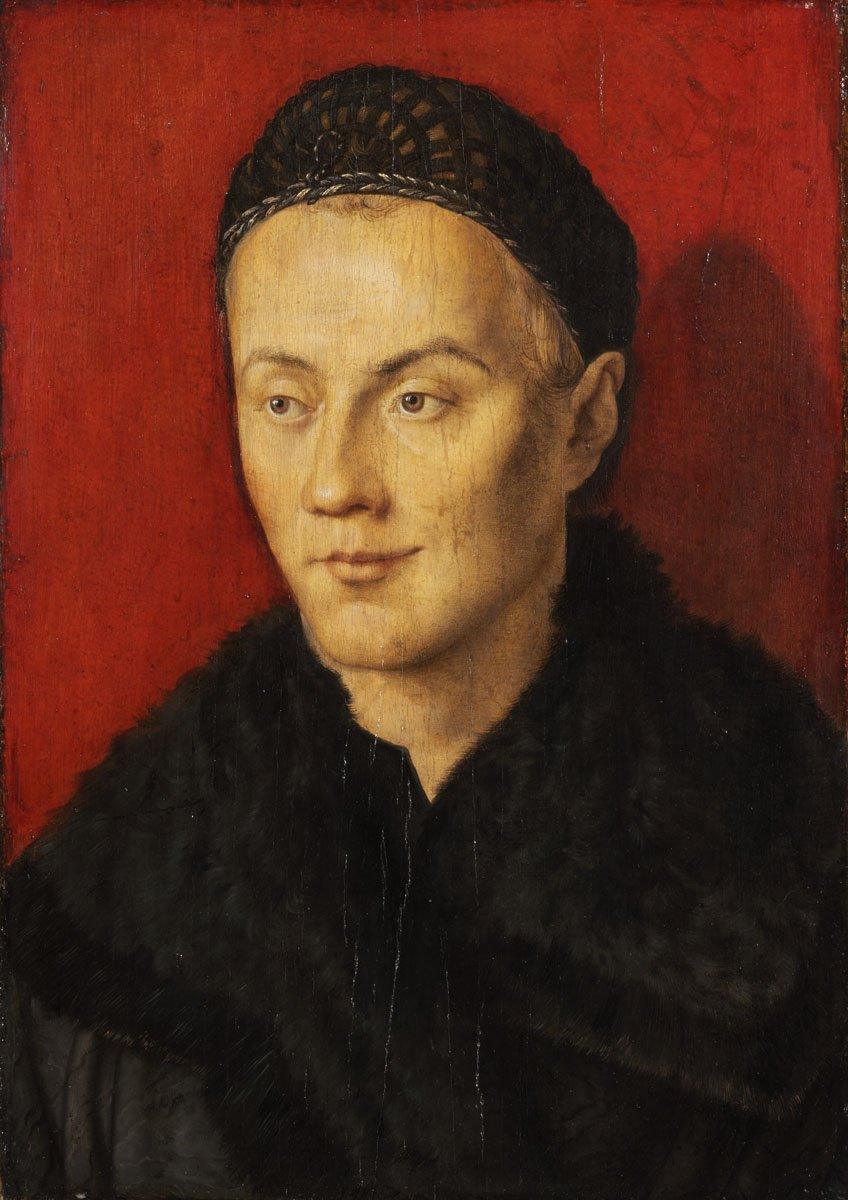
Dürer, Albrecht (1471-1528)
Portrait of a Young Man
c.1500–1510
Oil on pine, 43 × 29 cm
Museum of Fine Arts, Budapest
Albrecht Dürer was indisputably the greatest sixteenth-century painter north of the Alps. Not only did he have a God-given talent, he was also an exceptionally deliberate and self-aware master. He travelled round Italy several times, thoroughly working through everything important, and making use of what he considered good. But he found his home tradition more beneficial, and since the theoretical basis was lacking, he decided to create it. ‘The more rigorously your work adheres to life, the better it will appear. So you should never wonder whether you could do better than that with which God has endowed the natural world he created,’ runs Dürer’s alternative to the idealising Italian aesthetics. In the small painted portrait he did not wish to ‘correct’ the work of nature, the strange, asymmetrical smile of this young German. How right he was! For it is precisely this lopsided smile that is the key to the aura, which makes the man enigmatically interesting, but also magically alive. A host of scholars have claimed for decades that the mysterious smile could only have been inspired by Leonardo, yet it is an integral outcome of Dürer’s own principles. (Axel Vécsey, MFAB)