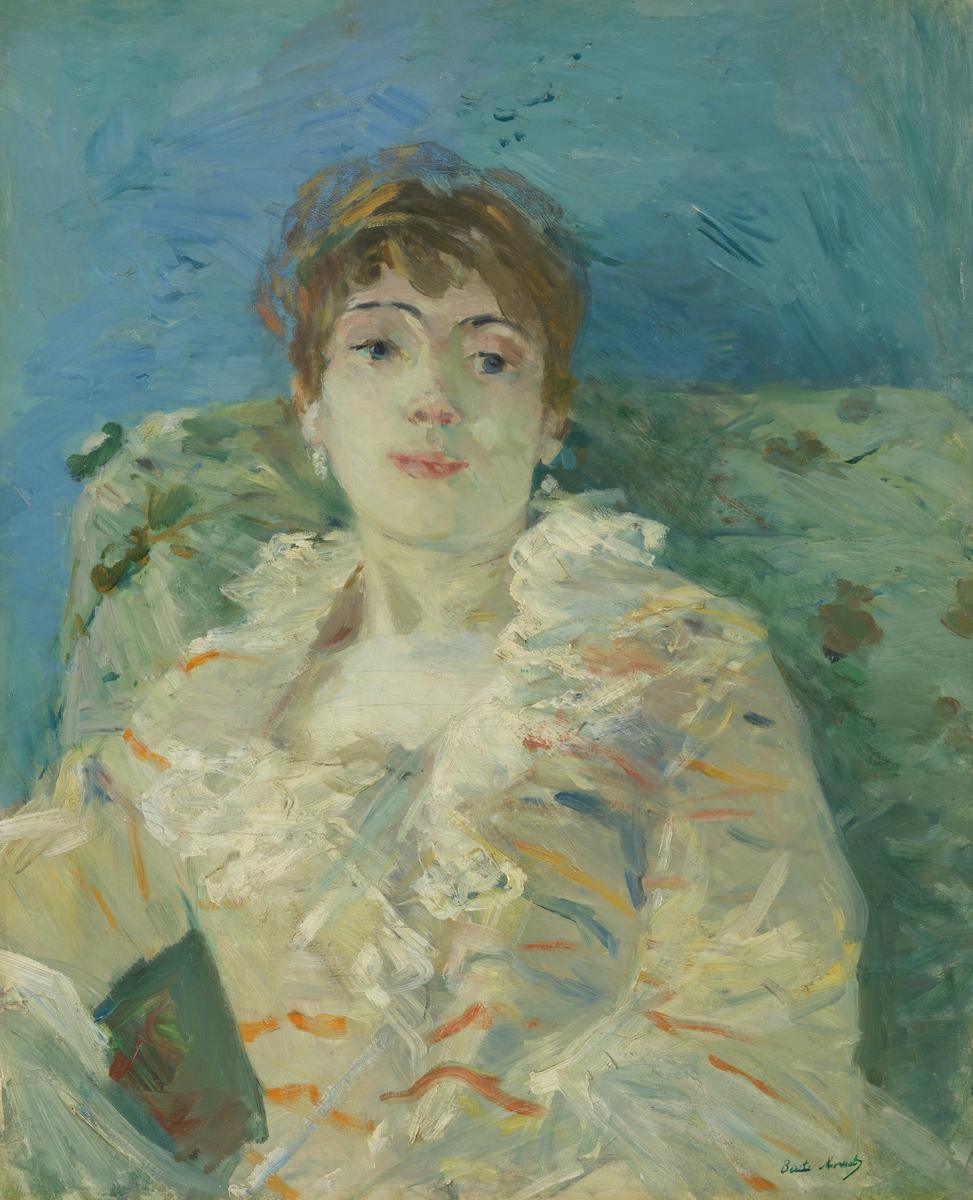
Morisot, Berthe (1841-1895)
Jeune femme au divan (Girl on a Divan)
c.1885
Oil on canvas, 61 x 50.2 cm
Tate Britain, London
The artist’s grandson Denis Rouart writes (9 October 1969): ‘This painting was sold by my mother direct to Vollard a long time ago, possibly during the 1914–18 war, possibly before, or shortly after. The studio stamp was put on it by my mother herself.
‘The woman represented is certainly a model, if not a professional one, at least one who sat now and then for payment. She is not a relation or a friend. However, my mother did not know her name.
‘As for the date, the handling of paint is characteristic of the period 1882 to 1888 and especially 1883–7. It is the same as that of the two portraits of Paule Gobillard dated by my mother one in 1884 and the other in 1887 (nos.159 and 209 in the Wildenstein catalogue) and if my mother assigned it to 1885 it was because she had some reasons either documentary or of personal judgement to place it then. There is in any case no sound reason for changing the date. The picture must certainly be later than 1880.’
Published in: Ronald Alley, Catalogue of the Tate Gallery’s Collection of Modern Art other than Works by British Artists, Tate Gallery and Sotheby Parke-Bernet, London 1981, p.542, reproduced p.542. (Tate)
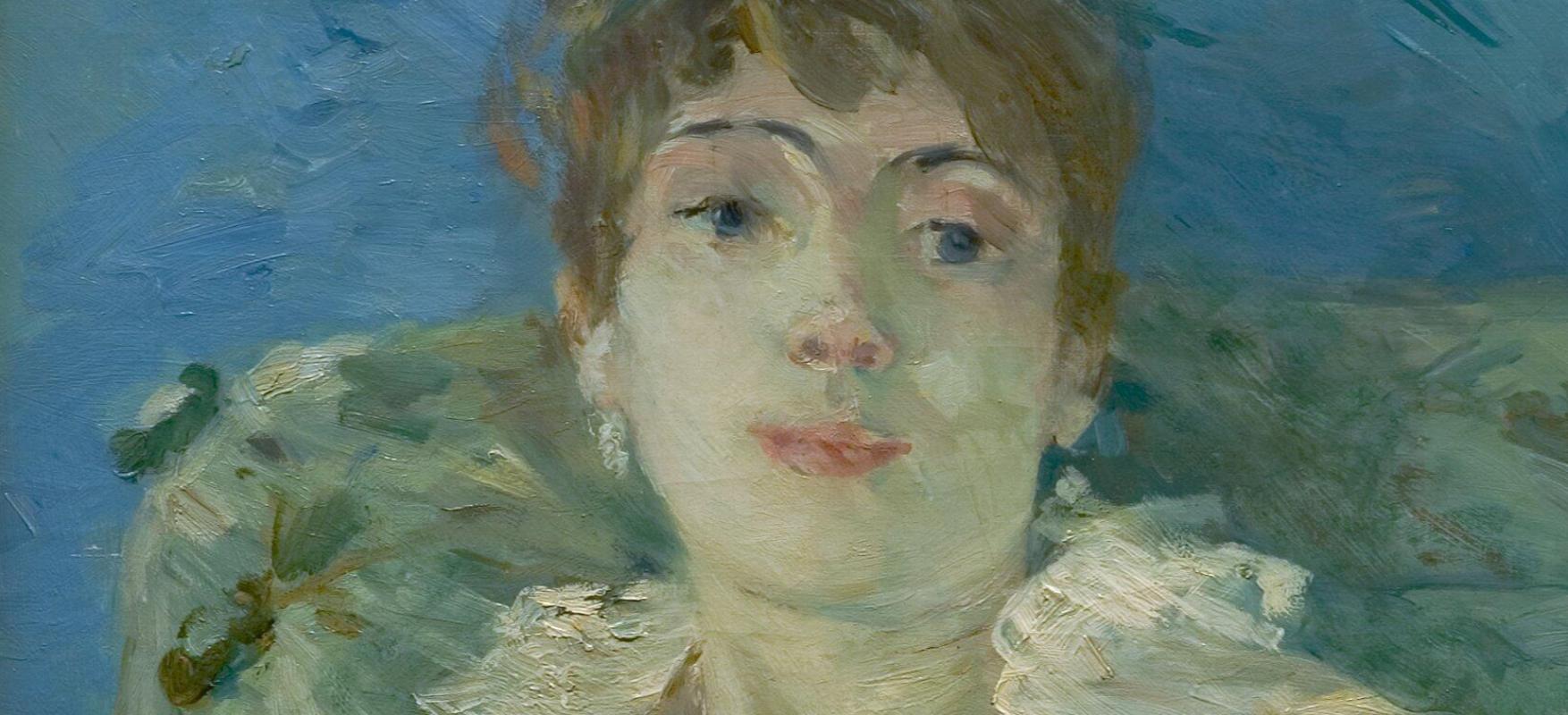
The sitter for this portrait has never been identified. Morisot lends a certain nonchalance to the young woman’s pose. There is a hint of dynamism too, as she leans against the armrest but turns her head in the other direction. Her face has a slightly wry expression. Perhaps she is amused by a conversation or lost in a train of thoughts or memories. Her strikingly blue eyes are emphasised by the matching background.
The model wears pendant silver earrings set with pearls. These are painted with such a light touch that they seem to shimmer on the canvas. Her dress has a ruffled collar and flared sleeves. It is stylishly cut, as you might expect of a woman with a certain status. Morisot has depicted its blue and orange pattern with a few quick brushstrokes, adding an energy to the picture.
The woman’s hairstyle is also interesting. She appears to have a fringe, which was unusual for the time, but the cut is not quite as short as it first looks. Her tresses are probably gathered or plaited and then pinned up. Morisot has sketched them in so lightly that they seem to merge with the background.
The setting is likely to be Morisot’s studio in Paris, which was in the salon of her house at 40 rue de Villejust. We know this because the fabric on the divan, or couch, features in other paintings by her. Morisot had moved into the first two floors of the newly built house about a year earlier. The writer Paul Valéry lived at the same address on the fourth floor and the street was eventually renamed after him.
Morisot was one of the founding members of the Impressionist movement and at the centre of the radical artistic circles of Paris in the later part of the nineteenth century. Her work was included in the first Impressionist exhibition of 1874 and in all but one of the subsequent shows. In the same year she married Eugène Manet, brother of the painter Édouard. She continued to paint under her own name until she died in 1895, at the age of only 54.
Morisot had always kept the painting. It was only sold after her death by her daughter, Julie. In 1969 Julie’s son, Denis Rouart, explained what his mother had told him about the picture. He said she had dated it to 1885: ‘The studio stamp [of Morisot’s signature] was put on it by my mother herself. The woman represented is certainly a model, if not a professional one, at least one who sat now and then for payment. She is not a relation or a friend. However, my mother did not know her name. As for the date, the handling of the paint is characteristic of the period 1882 to 1888 and especially 1883–7…and if my mother assigned it to 1885 it was because she had some reasons either documentary or of personal judgement to place it then. There is in any case no sound reason for changing the date.’ (NG)