Tiziano (c.1488-1576)
Ritratto del conte Antonio di Porcia e Brugnera (Portrait of Count Antonio Porcia and Brugnera)
1535–1540
Oil on canvas, 115 x 93 cm
Pinacoteca di Brera, Milano
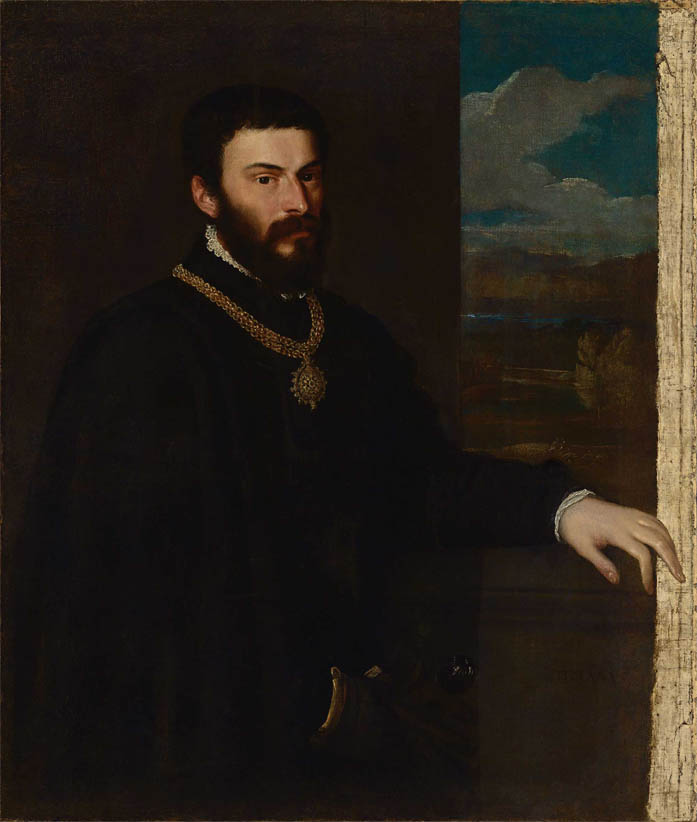
The painting, signed on the windowsill, portrays the Friulian nobleman Antonio di Porcia, born around 1508. It dates back to the mature phase of Titian‘s portraiture, in which the artist emphasizes the social importance of the subjects (the knight’s collar, the sword, the black suit) not only highlighting the ideal aspects as in his youthful works. The window opens onto a river and mountain landscape, according to a compositional formula already used in previous portraits. From the Porcia family castle in Pordenone, the work had passed to Milan, to the residence of Alfonso Porcia, from there it was inherited by Eugenia Litta Visconti Arese: the latter donated it to Brera in 1891.
Restoration began in March 2014 and was completed in October of the same year.
The painting can be dated between 1535 and 1540, and is signed in capital Latin characters on the sill on the right: “TITIANVS”. Count Antonio Porcia was a member of an important Friulian lineage.
The canvas, originally placed in the family castle, passed by inheritance first to Carinthia and then to Milan, to be donated to the Pinacoteca di Brera in 1891.
Before being delivered to the Gallery, the work was entrusted to the famous restorer Luigi Cavenaghi. The work had undergone some tampering over time, due to repeated format changes with adaptation of the frame and cornice, which had significantly damaged it around the perimeter. There were also tears in the backing canvas and other damage, to remedy which the painting had been applied to a remodeled canvas and extensively retouched. In addition, a black layer had been spread over the entire background that cut out the figure’s outline, completely covering the landscape, the dark background, and the signature. (Brera)
See also:
• Porcia e Brugnera, Count Antonio di (c.1508-)